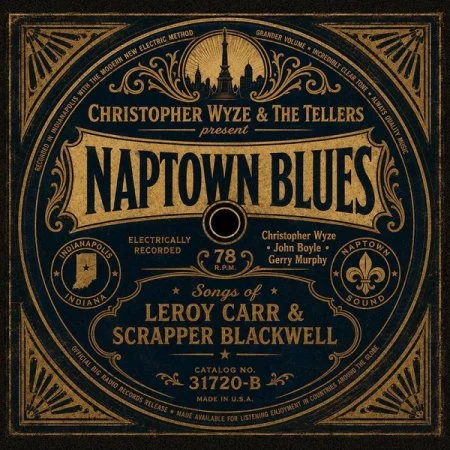
The contemporary blues landscape has long relied on reverence for the past to fuel its future, yet few modern acts dedicate an entire project to unearthing specific regional histories with the meticulousness found on Christopher Wyze & The Tellers’ third studio album, Naptown Blues, released via Big Radio Records. Comprising 11 tracks that span roughly 40 minutes of runtime, the record serves as a direct sonic monument to Leroy Carr and Scrapper Blackwell, two foundational architects of early 20th-century blues who forged their legendary partnership in Indianapolis—historically and colloquially referred to by the local African American community as "Naptown."
With this latest release, Wyze, a Southern Indiana native who embarked on a late-blooming musical career, balances historical preservation with artistic interpretation. The tracklist features ten classic compositions originally penned or popularized by Carr and Blackwell, alongside one contemporary-styled original cut inspired directly by their enduring legacy. Through deliberate instrumentation and a focused editorial vision, the trio—consisting of Wyze on lead vocals and harmonica, John Boyle II on guitars and Hammond organ, and Gerry Murphy on bass across eight tracks—delivers a project that bridges a century of American musical evolution.
The Historical Crucible: Carr, Blackwell, and the Indianapolis Sound
To understand the weight of Naptown Blues, one must examine the historical significance of Leroy Carr and Scrapper Blackwell, whose musical partnership fundamentally shaped the trajectory of urban blues. Carr, an exceptional vocalist and pianist, and Blackwell, an innovative, highly influential guitarist, both gravitated toward Indiana during an era of significant internal migration and cultural shift. When the two men were introduced in Indianapolis, they recognized an immediate creative synergy.
In 1928, Vocalion Records recognized the commercial potential of this regional phenomenon, bringing portable recording equipment into the field to capture their raw sound. Between 1928 and 1935, Carr and Blackwell recorded an estimated 100 to 200 songs, creating a sophisticated, laid-back style of blues that heavily influenced subsequent generations of musicians. Their breakthrough hit, "How Long—How Long Blues," recorded during those seminal 1928 sessions in Indianapolis, catapulted them to national prominence. Despite Carr’s tragically brief life—he passed away in Indianapolis in 1935 at the young age of 30—the duo’s catalog remains a cornerstone of American blues history.
Chronology and Track Analysis: Tracing the Roots
Naptown Blues meticulously navigates the chronology and geographic origins of Carr and Blackwell’s extensive discography. The album opens with "Going Back To Tennessee," a composition originally recorded in Chicago in 1930. Wyze and his band approach the material at a deliberate, metered tempo, anchoring the performance with steady electric bass and guitar accompaniment, punctuated by tasteful harmonica fills. This is immediately followed by the 1929 title track, "Naptown Blues," also captured during their Chicago sessions. Here, Wyze delivers emphatic vocals underpinned by a sharp harmonica line, while the rhythm section establishes a steady groove that culminates in a precise guitar solo.

A standout moment on the album is the stripped-down, somber rendition of "How Long—How Long Blues." Opting for a stark, bare-bones arrangement, Wyze pairs his vocals and acoustic harmonica with minimalist acoustic guitar work, subtly enhanced by overlaid electric guitar licks. This thoughtful minimalism captures the melancholic essence of the original 1928 recording.
Moving further into the tracklist, "The Truth About the Thing"—another 1929 Chicago recording—features intricate acoustic finger-picking, with Wyze infusing the mid-tempo number with palpable emotional resonance. The focus then shifts back to the local geography with "My Own Lonesome Blues," a product of the 1928 Naptown sessions. The track highlights exceptional acoustic guitar craftsmanship alongside a mournful harmonica solo that lives up to the song’s title.
The sequencing maintains its atmospheric depth with "Midnight Hour Blues," a laid-back, reflective piece originally recorded in 1935. On this track, the introduction of a Hammond organ by John Boyle II elevates the mood, blending seamlessly with the acoustic foundation. Similarly, "Kokomo Blues" highlights the technical proficiency of the finger-style acoustic guitar work, a hallmark of Blackwell’s original playing style.
The historical tapestry deepens with "Tired Of Your Low Down Ways," a late 1928 Chicago recording. Beyond its musical merits, the song holds a unique place in American folklore: it contains the earliest known recorded literary or musical reference to wearing overalls for Christmas—a lyrical motif later adopted by blues luminaries such as Lead Belly and Howling Wolf, though notably omitted from the Mississippi Sheiks’ famous adaptation, "Sittin’ On Top Of The World."
The album’s closing sequence returns firmly to the Indianapolis recording sessions. "You Got to Reap What You Sew" features a haunting electric guitar arrangement, while "Prison Bound Blues" incorporates relaxed slide guitar, understated vocals, and subtle harmonica accents, resulting in a polished and cohesive execution. The record concludes with "Birthday in Jail," a clever contemporary reworking of Carr and Blackwell’s 1932 seasonal novelty track, "Christmas In Jail-Ain’t That a Pain." Wyze reimagines the narrative with a steady, slow-burning guitar groove and energetic harmonica runs, offering a fresh perspective on a nearly century-old composition.
Musical Evaluation and Instrumentation
From a performance standpoint, Christopher Wyze delivers steady, reliable vocals that prioritize narrative clarity and emotional authenticity over virtuosic flash. His harmonica playing serves as a complementary textural layer throughout the record, functioning more as a horn section or atmospheric swell than a dominant solo instrument.
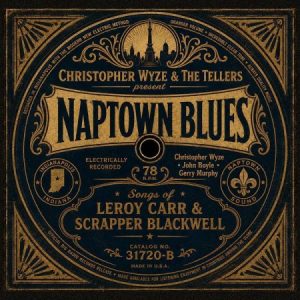
However, critical evaluation of the project inevitably points to a distinct instrumental absence: the piano. Given that Leroy Carr was one of the preeminent pianists of the early blues era—whose keyboard style was equal in importance to Scrapper Blackwell’s guitar work—the complete omission of piano on Naptown Blues represents a noticeable stylistic pivot. Without the rolling, blues-inflected piano chords that defined original recordings like "How Long—How Long Blues," the weight of the arrangement falls almost entirely on John Boyle II’s guitar and Gerry Murphy’s bass.
Despite this missing element, Boyle’s guitar work emerges as the undeniable standout feature across all eleven tracks. Whether navigating complex finger-picking patterns on acoustic numbers or executing tasteful melodic phrasing on electric and slide configurations, the guitar arrangements successfully honor the intricate interplay that originally defined the Carr-Blackwell dynamic.
Broader Impact and Industry Implications
The release of Naptown Blues by Big Radio Records underscores a growing commercial and cultural appetite for regional blues archeology. In an era where modern blues releases frequently lean toward high-gain rock-blues fusions or contemporary pop-blues crossovers, projects like Wyze’s serve an essential archival function. By explicitly reintroducing 1920s and 1930s Indianapolis blues history to a contemporary audience, the album encourages listeners to look beyond the more heavily commercialized Delta and Chicago blues traditions.
Furthermore, the project highlights the viability of "late-blooming" career trajectories within the genre. Wyze’s transition from a regional enthusiast to a recording artist documenting the roots of Indiana blues demonstrates that deep generational knowledge and historical respect can compensate for a lack of early-career exposure. While purists may debate the artistic decision to omit piano from a tribute to Carr and Blackwell, Naptown Blues ultimately succeeds as a respectful, well-executed homage to two of the most significant yet occasionally overlooked architects of American blues music.