Reimagining the Silence: Irish National Opera Stages Colm Tóibín’s Testament at the Dublin Theatre Festival

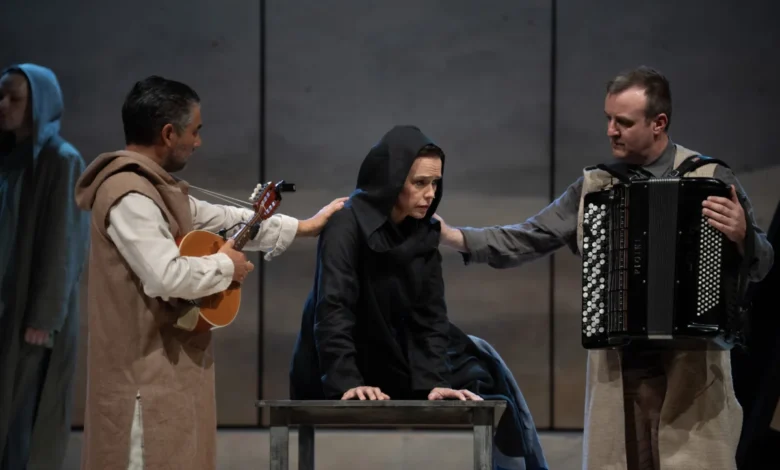
The intersection of literature, contemporary opera, and theological revisionism took center stage as the Irish National Opera mounted a compelling new production of Testament at the Dublin Theatre Festival. Based on Colm Tóibín’s acclaimed 2012 novella The Testament of Mary—which itself originated as a one-woman play premiered at the 2011 Dublin Theatre Festival—the 80-minute chamber opera features a score by composer Tarik O’Regan. Staged with an acute focus on modern aesthetic sensibilities and psychological depth, the production places the mother of Jesus at the narrative center, stripping away centuries of ecclesiastical tradition to examine the human cost of martyrdom, the politics of historical ownership, and the agonizing grief of a mother surviving her son.
Chronology of a Literary and Musical Evolution
The journey of Testament spans over a decade and a half, tracing a deliberate creative evolution from dramatic monologue to epic prose and, finally, to lyrical stagecraft. In 2011, Colm Tóibín’s original theatrical experiment debuted in Dublin, presenting Mary as an isolated, traumatized figure recalling the life of her son through a lens that diverged sharply from the canonical Gospels. Recognizing the expansive potential of the character’s interiority, Tóibín expanded the material into a novella, The Testament of Mary, published in 2012.
The text introduced supporting characters to anchor Mary’s recollections in a tangible social reality, providing a springboard for the Irish National Opera’s 2026 staging. The opera translates this literary framework into a multidisciplinary performance. By setting the narrative years after the crucifixion, the production eschews a strict chronological retelling of the New Testament. Instead, it presents a fractured sequence of memory—beginning disorientingly with the raising of Lazarus before meandering backward to the Wedding at Cana, and culminating in the shadow of the crucifixion and supposed resurrection. This non-linear chronology mirrors the cognitive patterns of aging and trauma, blurring the lines between past events and psychological torment.
Challenging Canonical Orthodoxies
At its core, the opera confronts the silence imposed upon Mary by biblical texts and subsequent religious traditions. Traditional hagiography presents a saintly, unwavering figure who willingly offers her son as the ultimate sacrifice for the salvation of mankind. Tóibín’s narrative, and by extension O’Regan’s musical adaptation, violently rejects this archetype.
In this interpretation, Mary is not a passive vessel of divine will, but a devastated mother who fled the crucifixion because the physical agony was too immense to bear. When pursued by her son’s disciples—depicted here as zealous architects of a new political and religious movement—she refuses to validate their claims of divinity. Her ultimate conclusion that the unimaginable suffering endured by Jesus “was not worth it” serves as a direct challenge to the theological framework of organized Christianity.
This thematic friction manifested beyond the proscenium arch. Prior to performances, representatives of traditional religious organizations staged peaceful protests outside the theater, underscoring the enduring sensitivity of subverting canonical narratives. The friction between the state-sanctioned orthodoxy of the early Church and a mother’s proprietary grief forms the dramatic engine of the production, raising fundamental questions regarding who holds the ultimate authority to dictate historical and spiritual legacies.
Vocal and Dramatic Performances
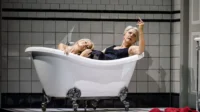
Mezzo-soprano Sharon Carty delivered a towering central performance as Mary, anchoring the production’s emotional weight. Carty navigated the character’s volatile psychological shifts with rigorous vocal control and theatrical intensity. Her portrayal captured a woman simultaneously prone to short-tempered demands to be heard and periods of catatonic withdrawal where trauma defied linguistic expression. Rather than relying on melodramatic histrionics, Carty utilized dynamic inflections to convey a potent mixture of grief, deep-seated pain, anger, and subtle paranoia. During the physical re-enactment of the crucifixion scene, her performance blurred the boundary between her own somatic distress and her son’s execution.
Surrounding Carty were six supporting cast members representing biblical figures reimagined through a critical lens. Maksym Lozovyi portrayed Lazarus as a non-speaking, disheveled wanderer who exhibited profound alienation rather than joyous renewal upon returning from the dead. Deirdre Higgins delivered a vocally assured performance as Martha, utilizing a strong upper register to articulate emotional torment, while mezzo-soprano Sarah Luttrell offered a warm, balanced, and expressively sensitive reading as Martha’s unnamed sister.
The disciples—John, Paul, and Markus—were characterized not as meek followers, but as an aggressive collective aggressively committed to propagating the narrative of Jesus as the Son of God. Tenors Oisín Ó Dálaigh and Ben Escorcio provided robust vocal support as Paul and Markus, while baritone David Kennedy stood out as John, utilizing a burnished, warm timbre and intelligent phrasing. Kennedy joined Higgins and Luttrell in a musically striking trio, blending their voices to create sophisticated tonal contrasts.
Directorial Vision and Scenography
Director Rachael Hewer, working alongside scenographer Francis O’Connor and costume designer Joan O’Clery, established a minimalist yet evocative staging. The visual design deliberately synthesized ancient motifs with modern aesthetics. While supporting characters and instrumentalists wore pastoral shades, Mary was starkly distinguished in dark, mourning attire. A prominent inclined mirror suspended above the stage offered audiences shifting perspectives, producing a striking visual spectacle during the crucifixion sequence.
The production’s staging choices emphasized central motifs of silencing and narrative control. Early in the performance, Mary appeared physically gagged, symbolizing the historical suppression of her voice before her "testament" could commence. Scribes positioned near the front of the stage served as a visual reminder of the act of recording and codifying history.
In a departure from traditional staging, the crucifixion sequence positioned Mary—rather than Jesus—strapped to the cross, visually reinforcing her complete identification with her son’s suffering. Later, the appearance of Jesus as a child evoked Mary’s happier memories, contrasting sharply with the black cross lingering in the corner of the stage, its beams lit by the inscription "Son of God"—a label Mary stubbornly resists to the final moment.
Uniquely, composer Tarik O’Regan insisted that the seven-piece instrumental ensemble be integrated directly onto the stage rather than confined to an orchestra pit. Hewer successfully incorporated the musicians into the dramatic action, requiring them to move among the singers and occasionally occupy center stage.
Musical Architecture and Score Analysis
Tarik O’Regan’s score functions primarily as a psychological and atmospheric vehicle, prioritizing dramatic momentum over lyrical indulgence. Utilizing an intimate ensemble comprising violin, viola, cello, flute/piccolo, clarinet, mandolin, and accordion—supplemented by subtle electronic soundscapes—O’Regan constructed a soundworld that frequently oscillates between accessible tonality and abrasive dissonance.
The musical apex of tension occurred during the crucifixion sequence, where the score adopted an aggressive, rhythmically jagged profile designed to discomfort the listener. Conversely, moments such as the Wedding at Cana featured more accessible, rhythmic dance patterns, though some reviewers noted that the physical choreography during these interludes occasionally struggled to match the sophistication of the music.
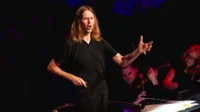
Under the baton of conductor Elaine Kelly, positioned separately in the pit, the ensemble delivered a high-energy, texturally rich performance that highlighted O’Regan’s complex orchestration. While some critics observed that the contemporary score occasionally leaned into a generic idiom common to modern chamber opera, its efficacy in driving the psychological stakes of the drama remained undisputed.
Broader Cultural Implications
The staging of Testament by the Irish National Opera highlights a growing appetite within contemporary performing arts to deconstruct foundational cultural myths and re-examine canonical figures through modern critical lenses. By shifting the perspective from divine glorification to maternal trauma, the production touches upon universal themes of grief, bodily autonomy, and the contested ownership of historical memory.
As institutional and cultural landscapes continue to re-evaluate traditional narratives, works like Testament demonstrate the capacity of opera and contemporary theatre to foster critical discourse. By challenging audiences to look beyond sanctioned orthodoxies, the production ultimately asks viewers to reconsider not only the life of a historical figure, but the mechanisms by which historical consensus is constructed, maintained, and contested.