The debut of Liza Lim’s latest masterwork, The Tailor of Time, marks a significant milestone in the evolution of contemporary music theatre and ritualized performance. Commissioned and presented as part of the "New in VAN" series, this production represents a profound exploration of the intersection between materiality, temporal philosophy, and the auditory arts. Featuring the acclaimed percussionist and performance artist Aditya Ryan Bhat, the work transcends traditional operatic boundaries, utilizing a multidisciplinary approach that incorporates kinetic sculpture, textile metaphors, and avant-garde percussion techniques. Captured through the lens of photographer Lauren Murphy and analyzed by critic Ty Bouque, the production challenges the audience to reconsider the act of storytelling not as a linear progression, but as a tactile, woven experience.
The Metaphor of the Needle: Sewing as Compositional Strategy
At the heart of The Tailor of Time is the central conceit of "sewing" a story. Liza Lim, an Australian composer renowned for her ability to fuse diverse cultural aesthetics with "New Complexity" structures, has long been preoccupied with the physical nature of sound. In this work, she utilizes the metaphor of the needle and thread to describe the way time is punctured and joined. The composition does not merely progress through a chronological score; instead, it "stitches" together disparate moments of resonance, silence, and physical movement.
The conceptual framework draws heavily from Lim’s previous explorations into Sufi mysticism and indigenous Australian cosmologies, where time is often viewed as a multidimensional fabric rather than a forward-moving arrow. By adopting the persona of a "tailor," the performer—Aditya Ryan Bhat—acts as a mediator between the tangible world of objects and the ephemeral world of sound. This role requires a unique blend of technical musical proficiency and theatrical presence, as the "score" involves the manipulation of physical materials that generate sound through friction, impact, and suspension.
Aditya Ryan Bhat and the Kinetic Performance
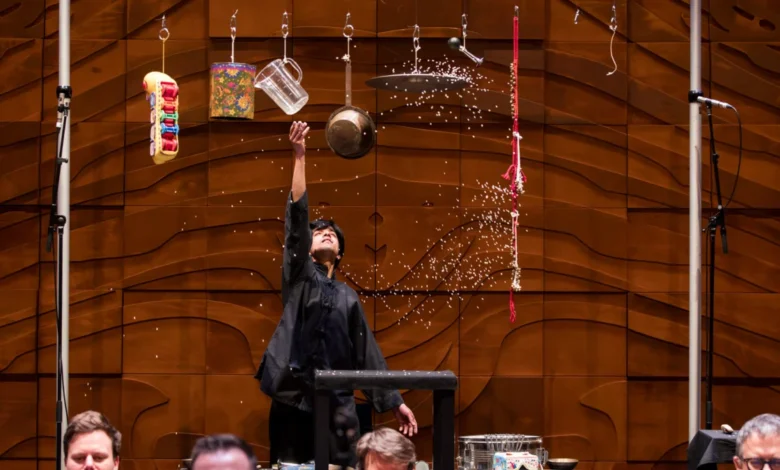
Aditya Ryan Bhat’s contribution to The Tailor of Time is foundational. Known for his work in experimental percussion, Bhat brings a heightened level of physicality to the stage. In this production, the percussionist’s traditional toolkit is expanded to include what the production notes describe as "flying objects." These are not merely props but are integral components of the instrumentarium.
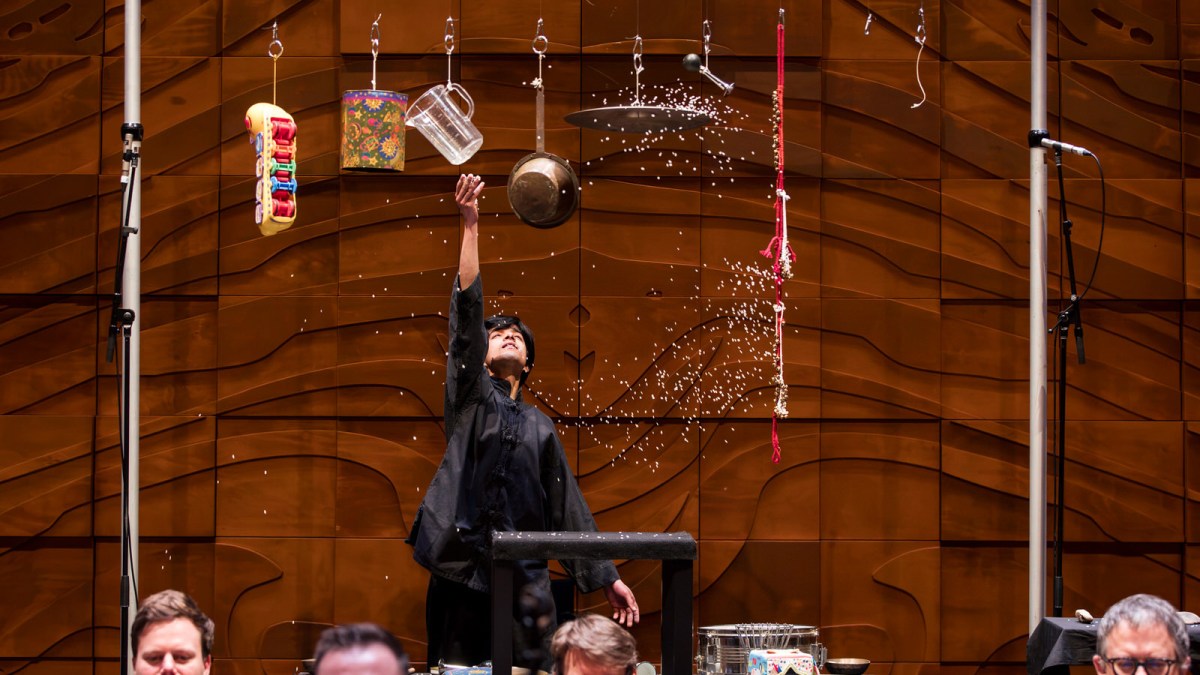
The "flying objects" consist of a series of suspended kinetic sculptures that react to the performer’s movements. As Bhat navigates the stage, he interacts with these objects—sometimes with a delicate touch akin to a seamstress handling silk, and at other times with the forceful precision of industrial machinery. The interaction creates a localized soundscape where the acoustics are determined by the proximity and velocity of the objects in motion. This spatialized approach to sound ensures that no two performances are identical, as the physical variables of the "flying objects" introduce an element of controlled chance into the performance.
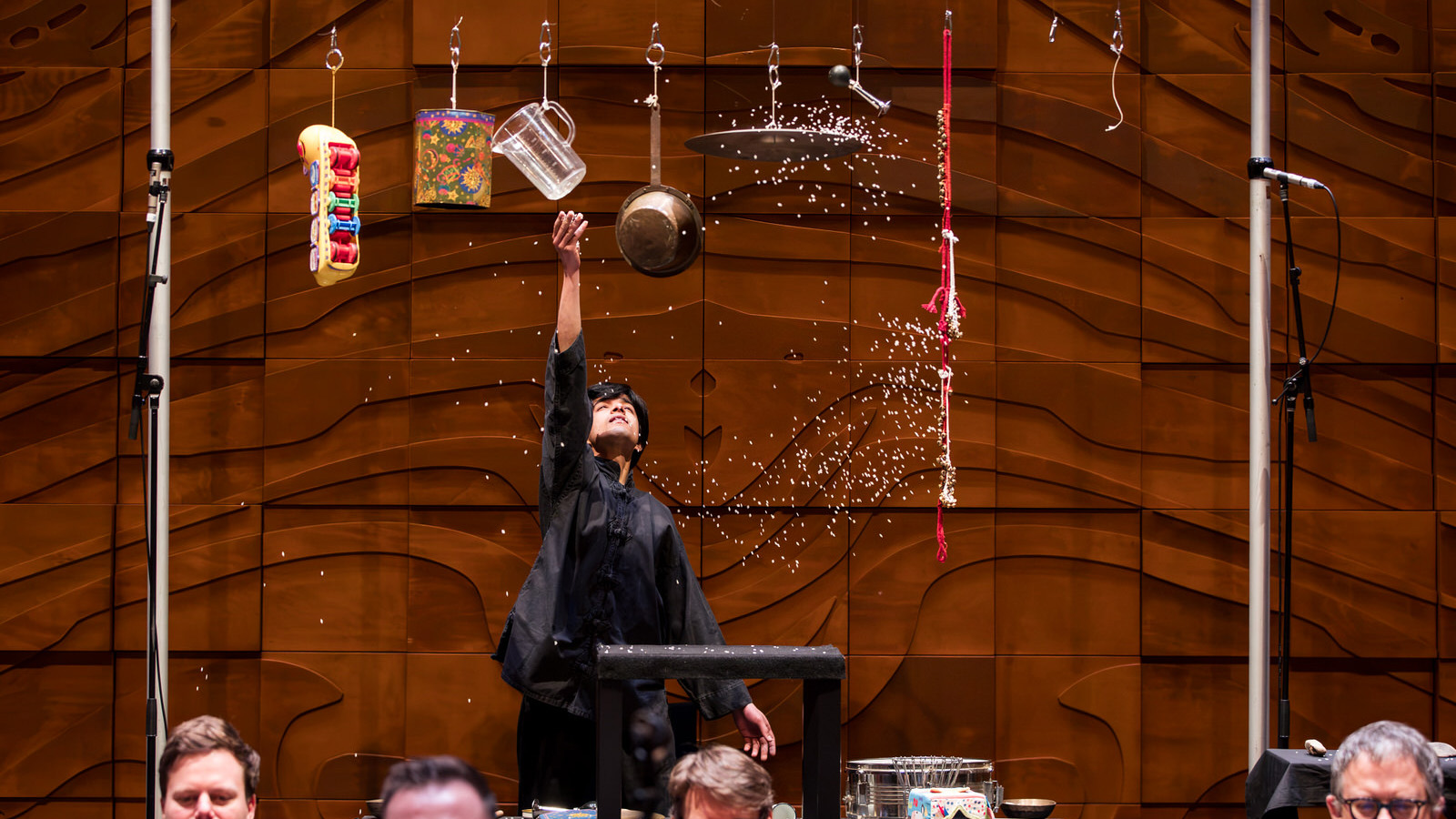
The visual component, documented by Lauren Murphy, emphasizes the tension between the performer and the environment. The photography reveals a stark, almost ritualistic setting where the play of light and shadow on the suspended objects mirrors the fluctuating dynamics of Lim’s score. The performer is often seen engulfed by these materials, suggesting a narrative of a creator being consumed by their own creation—a common theme in Lim’s exploration of the "sensual bodies" involved in music-making.
Contextualizing Liza Lim in Contemporary Music
To understand the impact of The Tailor of Time, one must look at Liza Lim’s broader career trajectory. As a professor at the University of Sydney and a frequently commissioned composer for ensembles such as ELISION and the Arditti Quartet, Lim has established herself as a leading voice in ecological and ritualistic music. Her previous works, such as Extinction Events and Dawn Chorus and the opera Tree of Codes, have set a precedent for using music to address complex philosophical and environmental issues.
The Tailor of Time continues this lineage by addressing the "slippery histories" of music theatre. While traditional opera has often been criticized as a "dead genre," Lim’s work argues for its rebirth through hybridization. By stripping away the conventional trappings of the opera house—large orchestras, linear librettos, and static staging—she creates a space where the "work of mourning" for the genre becomes a generative act. This piece is less about the grand artifice of the past and more about the intimate, tactile realities of the present.
Technical Specifications and Structural Analysis
Structurally, The Tailor of Time is divided into sections that mimic the process of garment construction: the cut, the seam, the fold, and the finish. Each section employs specific percussive textures to represent these actions.
- The Cut: Characterized by sharp, transient sounds—clicks, snaps, and the shearing of metal—this movement establishes the initial fragmentation of silence.
- The Seam: This movement introduces sustained tones and drones, created through the use of friction on the "flying objects" and the dragging of heavy fabrics across the stage floor. It represents the joining of disparate temporalities.
- The Fold: A more introspective section where the density of the sound increases, creating layers of resonance that overlap and obscure one another, much like the layers of a heavy cloak.
- The Finish: The final movement returns to a state of transparency, where the "flying objects" gradually come to a rest, and the performer is left with the residual silence of a completed work.
The use of electronics in the piece is subtle but pervasive. Rather than providing a pre-recorded backing track, the electronic elements are used to amplify and transform the live acoustic sounds in real-time. This creates an "augmented acoustic" environment where the boundaries between the physical object and the digital shadow are blurred.
Industry Impact and the Role of Commissioned Content
The presentation of The Tailor of Time within the "New in VAN" framework highlights a growing trend in arts journalism and institutional support. The project was commissioned and funded by "New in VAN," an initiative designed to foster the creation of ambitious new works that might otherwise struggle to find a foothold in the commercial classical music market.
While the editorial staff of VAN Magazine remained independent of the creation process, the platform provided for the work ensures a level of visibility that is crucial for contemporary composers. This model of "advertiser content" in the arts represents a shift toward more direct corporate and institutional patronage of the avant-garde. For Liza Lim, this support allows for the realization of high-concept projects that require extensive research, development, and specialized performers like Bhat.
Broader Implications for the "Dead Genre" of Opera
In his analysis of the work, Ty Bouque notes that The Tailor of Time participates in the "work of mourning for a dead genre." This perspective suggests that the traditional opera, as it existed in the 18th and 19th centuries, is no longer a viable vessel for contemporary expression. However, by embracing this "death," composers like Lim are free to scavenge the ruins of the genre to build something entirely new.
The implications of this shift are twofold. First, it democratizes the performance space, moving away from the "cathedrals of culture" toward more flexible, installation-based environments. Second, it shifts the focus from the voice as the primary vehicle of narrative to the body and the object. In The Tailor of Time, the "story" is not told through words but through the physical labor of the performer and the resulting acoustic phenomena.
Conclusion
Liza Lim’s The Tailor of Time stands as a testament to the enduring power of ritual and materiality in an increasingly digital age. By focusing on the elemental act of sewing—the simple joining of one thing to another—Lim has created a complex meditation on the nature of existence and the passage of time. Through the virtuosic performance of Aditya Ryan Bhat and the innovative use of kinetic objects, the work offers a compelling vision of what the future of music theatre can be: tactile, spatial, and deeply human. As the "flying objects" of the production settle and the echoes of the percussion fade, what remains is a profound sense of the "garment of time" that Lim has so meticulously crafted.