The evolution of the electric guitar has been defined by a constant tension between acoustic resonance and electronic amplification. For decades, instrument designers and manufacturers grappled with a fundamental physical limitation: fully hollow-bodied guitars, while offering rich acoustic properties, were inherently prone to uncontrolled audio feedback when paired with high-output amplification. This acoustic vulnerability catalyzed the development of the solid-body electric guitar in the mid-20th century, forever changing the landscape of popular music. However, the subsequent introduction of the semi-hollow design offered a vital middle ground—combining the sustain and feedback resistance of a solid-body with the warmth, air, and resonance of a traditional archtop. Examining the historical trajectory, structural mechanics, and practical applications of semi-hollow instruments reveals why these versatile guitars remain an indispensable tool for modern musicians across genres.
Historical Evolution: From Feedback Crises to the Golden Era of Design
To understand the enduring appeal of the semi-hollow guitar, one must examine the timeline of electric guitar innovation. In the early decades of the twentieth century, guitars were built primarily as acoustic instruments. As big band music grew in popularity, guitarists demanded greater volume to compete with horns and drums. Early amplification attempts using fully hollow archtop bodies resulted in catastrophic low-frequency feedback loops as soundwaves from the amplifier excited the hollow chamber of the instrument.
This engineering hurdle prompted radical experimentation. In the 1930s, Rickenbacker introduced the Electro A-22 lap steel, colloquially known as the "Frying Pan," widely recognized as one of the earliest mass-produced electric guitars. Shortly thereafter, between 1939 and 1940, guitar innovator Les Paul constructed "The Log," an experimental solid piece of pine fitted with a neck, pickups, and detachable hollow body wings, demonstrating that a solid mass could mitigate feedback entirely.
By the early to mid-1950s, industry giants Fender and Gibson formalized the solid-body revolution with the commercial release of the Broadcaster/Telecaster, the Stratocaster, and the Les Paul model. While these solid-body instruments solved the feedback problem and delivered unprecedented sustain, some players missed the woody resonance and organic tactile response of hollow bodies.
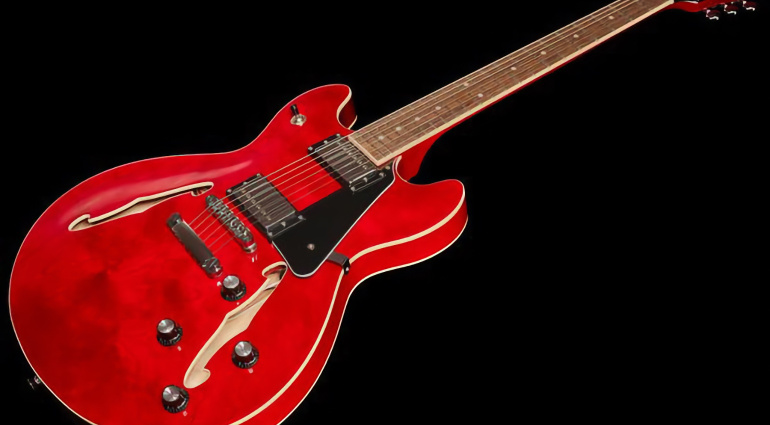
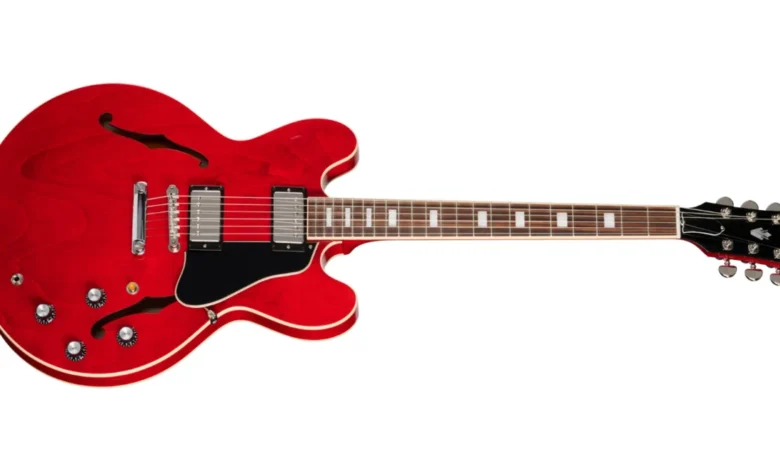
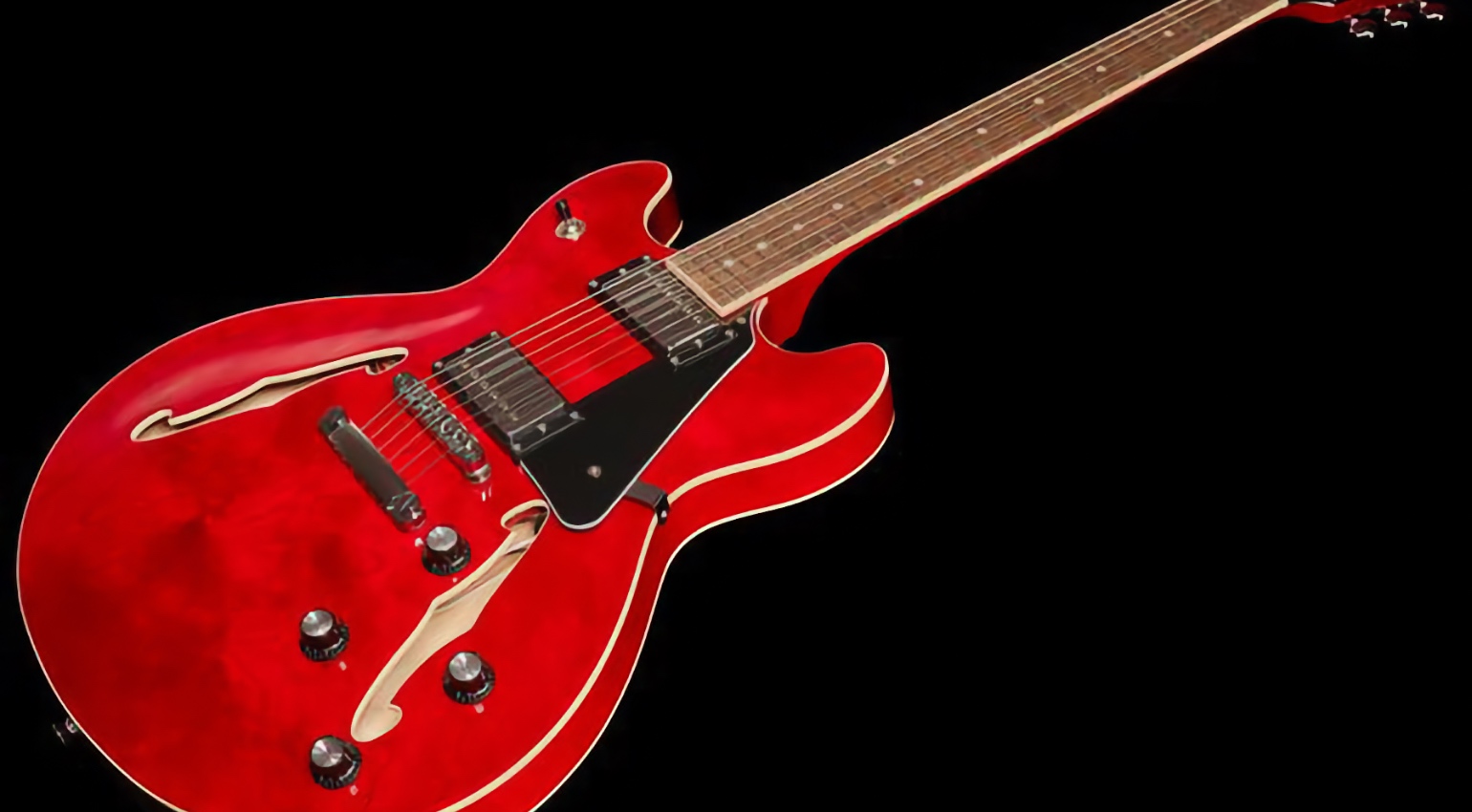
The industry responded in the late 1950s with the advent of the semi-hollow design. In 1958, Gibson introduced the ES-335, a groundbreaking "Electric Spanish" model featuring a solid maple center block running through the length of a laminated maple hollow body, flanked by two acoustic "F-holes." This central block provided the structural rigidity and mass needed to resist feedback while anchoring the bridge and pickups, whereas the hollow wings preserved acoustic resonance and reduced overall weight. Fender followed suit in the late 1960s with the Telecaster Thinline, incorporating a partially routed ash or mahogany body. Competitors such as Gretsch, Rickenbacker, and Guild soon expanded the market with their own distinct semi-hollow and thinline iterations, cementing the design archetype in music history.
Acoustic Resonance and Ergonomic Advantages in Modern Practice
Beyond their historical significance, semi-hollow guitars offer distinct ergonomic and sonic advantages that make them uniquely suited for contemporary songwriting and performance environments. One of the most immediate benefits is weight reduction. Traditional solid-body electric guitars—particularly mahogany-heavy designs like the Gibson Les Paul Custom—can impose significant physical strain during extended playing sessions, often leading to fatigue or discomfort when seated.

Semi-hollow and thinline instruments, by contrast, frequently feature chambered bodies that substantially reduce the overall weight of the instrument. This reduction makes them exceptionally comfortable for couch-based songwriting and casual practice. Furthermore, the partial acoustic chambers allow these guitars to project significantly more sound when played unplugged than a solid-body counterpart. While they do not match the acoustic volume of a dedicated steel-string acoustic guitar, their unplugged projection is sufficient for late-night writing sessions or environments where amplification is unavailable or impractical.
Dynamic Amp Interaction, Stage Volume, and Pedal Integration
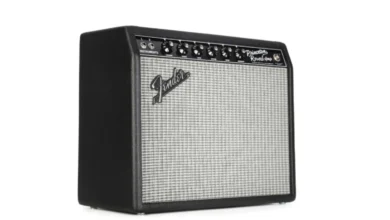
When plugged into an amplifier, semi-hollow guitars exhibit unique electro-acoustic interactions that differentiate them from solid-body instruments. At high stage volumes or in studio settings, the soundwaves emerging from the speaker cabinet interact physically with the vibrating top and internal air chambers of the guitar. This creates a responsive loop between the amplifier and the instrument, allowing players to induce controlled, musical sustain and harmonic feedback at lower thresholds than would be possible with a heavy solid-body guitar.

This acoustic coupling makes semi-hollows particularly responsive to naturally compressing tube amplifiers and dynamic overdrive pedals. When paired with high-gain fuzz pedals, semi-hollow guitars can produce a wild, textured, and harmonically rich soundscape that is distinctively organic. Conversely, when played clean, the design excels in touch sensitivity, reacting dynamically to subtle shifts in picking intensity and right-hand dynamics.
Musical Versatility Across Genres
Historically, semi-hollow guitars have transcended genre boundaries. In the hands of rock and roll pioneers like Chuck Berry, the ES-335 defined the searing, driving rhythm and lead tones of early rock. Decades later, artists ranging from blues icons like B.B. King to alternative rock heavyweights like Dave Grohl have relied on semi-hollow instruments for their distinctive sonic breadth.

Whether configured with traditional humbuckers for thick, warm mid-range tones, or single-coil pickups—such as P90s—for added bite and clarity, a well-constructed semi-hollow guitar can adapt to jazz, blues, rock, country, and indie music with equal proficiency. Their natural harmonic complexity fills out arrangements in both sparse trio settings and dense mix environments.
Accessibility, Market Options, and Setup Recommendations
Historically, owning a top-tier semi-hollow guitar required a significant financial investment, often restricted to flagship American-made instruments. However, contemporary manufacturing advancements have democratized the market. Major manufacturers and specialized budget-friendly brands—such as Thomann’s house brand, Harley Benton—now produce exceptionally well-crafted semi-hollow models at accessible price points. Instruments such as the Harley Benton HB-35 series or the Epiphone and Squier lines allow guitarists to experiment with semi-hollow tones without making a prohibitive financial commitment.

Industry experts and veteran guitar technicians frequently emphasize that the performance of a semi-hollow guitar is heavily dependent on professional setup. Because wood reacts dynamically to humidity and temperature changes, semi-hollow instruments benefit immensely from meticulous adjustments to neck relief, string action, intonation, and pickup height. Additionally, minor enhancements such as rolling the fretboard edges can dramatically improve playability, transforming an entry-level instrument into a responsive, professional-grade tool.
Implications and Industry Outlook
The enduring popularity of semi-hollow guitars underscores a broader preference among musicians for instruments that bridge the gap between traditional craftsmanship and modern utility. As manufacturing quality continues to rise across all price brackets, the barrier to entry for these versatile instruments has never been lower. For guitarists seeking to expand their sonic palette, reduce physical fatigue during long sessions, and explore the nuanced interplay between acoustic resonance and high-volume amplification, integrating a semi-hollow guitar into the rig represents a historically validated and creatively rewarding investment.