A to JazZ Festival Celebrates 15 Years of Musical Diversity and Global Cultural Exchange in Sofia

The A to JazZ Festival marked its 15th anniversary this July in Sofia’s South Park 2, reinforcing its position as one of the most significant cultural landmarks in Eastern Europe. Set against the backdrop of the Vitosha Mountains, which rise within the immediate periphery of the Bulgarian capital, the event once again transformed the city’s green spaces into a hub for international and local music. True to its name, the festival sought to embrace the full spectrum of jazz, from its traditional roots to contemporary world-music fusions, presenting an eclectic program that began each evening on its main stage. Since its inception, the festival has maintained a policy of free admission, a strategy that has successfully democratized high-art music and attracted a diverse demographic of listeners, ranging from seasoned jazz aficionados to young families. This year, under the influence of peak summer weather, the park’s lawns were densely packed with thousands of spectators, creating an expansive "ocean of picnic blankets" that necessitated careful navigation for those moving between the stage and the various cultural stalls.
A Strategic Focus on Global Rhythms and Fusion
The festival’s structure has evolved to provide a comprehensive view of the global music landscape. While the jazz-centric program traditionally anchors the weekend, the opening day on Thursday was dedicated to world-music showcases, a decision by organizers to highlight the intersections between folk traditions and improvisational music. Among the standout performances was a Carnatic trialogue led by Uma Ranganathan, an Indian vocalist currently based in Norway. Ranganathan’s performance served as a masterclass in the parallels between Indian classical music and jazz, specifically focusing on the element of improvisation. By blending the rhythmic complexities of Carnatic music with a modern sensibility, she illustrated the "natural affinity" that exists between disparate musical cultures.
Adding to the evening’s cultural synthesis was the Nubras Ensemble. This group successfully constructed a musical bridge between southern Italy and Bulgaria, a feat made even more poignant by the presence of Diyana Vasileva. As a member of the world-renowned "Mystery of the Bulgarian Voices," Vasileva brought a level of vocal prestige that grounded the ensemble’s experimental sounds in traditional Bulgarian folklore. This fusion of Mediterranean and Balkan influences highlighted the festival’s commitment to fostering cross-border artistic collaborations, proving that regional traditions can be reimagined for a modern, international audience.
The A to JazZ Conference: Navigating the Modern Music Industry
Parallel to the live performances, the festival hosted its annual music conference, a tradition established in 2018 to foster dialogue among industry professionals. The conference brought together festival directors, promoters, venue programmers, and journalists to discuss the evolving challenges of the music business. A key theme of this year’s discussions was the increasing difficulty of international touring, exacerbated by rising logistical costs and a resurgence of musical nationalism.
Paul Pace, a prominent figure in the British jazz scene, provided a historical perspective on these modern challenges. During his presentation, Pace revisited the legacy of Ronnie Scott’s, the legendary London jazz club. He recounted how co-founder Pete King negotiated a landmark reciprocal agreement with the American Federation of Musicians in the mid-20th century. This agreement was instrumental in allowing American jazz icons to perform in the United Kingdom, effectively breaking down isolationist barriers and establishing Ronnie Scott’s as a global destination for the genre. Pace’s narrative served as a reminder that the current hurdles facing the industry require the same level of diplomacy and international cooperation that defined the golden age of jazz.
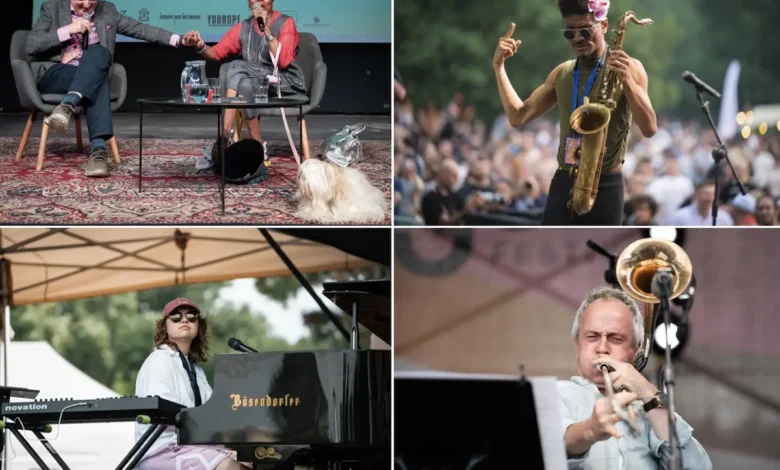
The conference took an unexpected turn when Pace was joined by the legendary vocalist Dee Dee Bridgewater for an impromptu discussion. Bridgewater, appearing with her service dog, Daisy, spoke with remarkable candor about her 56-year career. She reflected on the physical toll of performing in smoke-filled clubs during the early decades of her career and addressed the systemic sexism she encountered within the jazz community. Her "We Exist!" project, an all-female initiative, was presented as a direct response to the historical patriarchy of the genre. Bridgewater emphasized that the project is not merely about representation but about challenging the power structures that have long marginalized female instrumentalists and composers.
Headlining Highlights and the Miles Davis Legacy
The Saturday evening program culminated in a commanding performance by Bridgewater, whose set was as politically charged as it was musically brilliant. Before a crowd of several thousand, she performed Nina Simone’s "Mississippi Goddam," a song born from the American Civil Rights Movement. Bridgewater utilized the stage to draw parallels between the historical struggles of the 1960s and the current political climate in the United States, which she pointedly referred to as the "Ununited States." Her dedication of Bob Dylan’s "Gotta Serve Somebody" to the "orange king" left the audience in no doubt regarding her stance on contemporary American politics. Despite the heavy themes, her performance was characterized by a radiant energy that culminated in a moving, unaccompanied rendition of "Amazing Grace," a gesture that resonated deeply with the international audience.
The festival also paid homage to the legacy of Miles Davis, coinciding with the global celebrations of the jazz icon’s centennial year. The Miles Electric Band (M.E.B.), led by Davis’s nephew, drummer Vince Wilburn Jr., delivered one of Friday evening’s most high-energy sets. The 10-piece ensemble explored Davis’s influential electric period, covering a repertoire that spanned from the avant-garde textures of "Bitches Brew" (1969) to the more accessible, synth-heavy interpretations of the 1980s, such as Michael Jackson’s "Human Nature." The performance was a testament to Davis’s enduring influence and the ability of his music to remain relevant across generations.
Emerging Talent and the Evolution of the Genre
A to JazZ has consistently provided a platform for younger artists to showcase their work alongside established legends. This year, Polish pianist Hania Derej emerged as a standout figure. Representing a new generation of performers who blur the lines between jazz, atmospheric music, and pop aesthetics, Derej’s set moved from a traditional trio format into a more expansive, quartet-led sound. Her use of wordless vocals over the Bösendorfer piano, combined with a shift to electronic keyboards, demonstrated a sophisticated understanding of sonic texture. Her performance was noted for its "cool" demeanor—wearing sportswear and sunglasses—signaling a shift away from the formal attire traditionally associated with jazz performance.
In contrast, the performance by saxophonist Tomoki Sanders, son of the late Pharoah Sanders, highlighted the complexities of musical lineage. While the set began with considerable promise, analysts noted that it struggled to maintain momentum in its latter half. This served as a reminder of the unique pressures faced by the children of jazz legends, who must balance the preservation of a family legacy with the need to establish an independent artistic identity.
Bulgarian Jazz: A Thriving Local Scene
The festival remained a vital showcase for Bulgarian talent, both domestic and expatriate. Trombonist Gueorgui Kornazov, who has built a successful career in France, returned to Sofia to present his "Autumn Impressions" project. The ensemble’s unusual instrumentation—including accordion, tuba, and trumpet—offered a rich, brass-heavy sound that reflected the experimental nature of the European jazz scene.
Double bassist Victoria Kirilova also made a significant impression with her quartet. Performing tracks from her album "Roots & Skies," Kirilova demonstrated a deep expressiveness that has already garnered positive reviews from international publications like Jazz Journal. Her music, which blends technical proficiency with emotional depth, confirmed her status as one of the rising stars of the Bulgarian jazz diaspora.
Perhaps the most intellectually provocative set came from drummer Emil Tassev. A physicist by training, Tassev’s debut album, "Tesseract," is inspired by four-dimensional geometry. His quartet’s performance utilized mathematical concepts as a metaphor for exploring realities beyond human perception. The result was a complex, shifting musical landscape that challenged the audience’s expectations and showcased the intellectual rigor that often underpins modern jazz composition.
Cultural Impact and the Future of A to JazZ
As the main stage performances concluded each night at the 11 p.m. curfew, the energy of the festival shifted to Toplocentrala, a nearby indoor venue. These late-night jam sessions, featuring a mix of local musicians and festival headliners, provided a more intimate environment for artistic exchange. Notably, Veleka Tsankova, a member of the festival’s organizing team and an accomplished jazz vocalist, was among those who contributed to the nocturnal program, illustrating the deep-seated musical passion that drives the event’s administration.
Over the past 15 years, founder and director Peter Dimitrov has transformed A to JazZ from a local initiative into a cornerstone of the European festival circuit. By maintaining a free-access model, the festival has effectively countered the perception of jazz as an elitist genre, instead presenting it as a vibrant, living art form accessible to all. The success of the 2026 edition, characterized by its high attendance and international reach, suggests that the festival’s influence will only continue to grow.
The A to JazZ Festival is more than a series of concerts; it is a social and economic driver for Sofia. It boosts local tourism, supports the city’s night-time economy, and provides a crucial platform for the development of the Bulgarian music industry. As the crowds dispersed from South Park 2, the consensus among attendees and critics alike was that jazz in the Balkans is not only alive but thriving. The 15th anniversary served as a celebration of past achievements and a promising look toward the future of the genre in a rapidly changing global landscape.
A to JazZ, Sofia, Bulgaria, 2-5 July 2026. For more information, visit atojazz.bg/en.